 ML Info
Answered Non GamStop Casinos Reviews 2026 — What UK Reads
Search demand for non gamstop casinos reviews is heavy for a reason: readers want a second opinion before they deposit. This page describes what a genuinely useful review contains and how to read one critically.
What should a non-GamStop casino review actually contain?
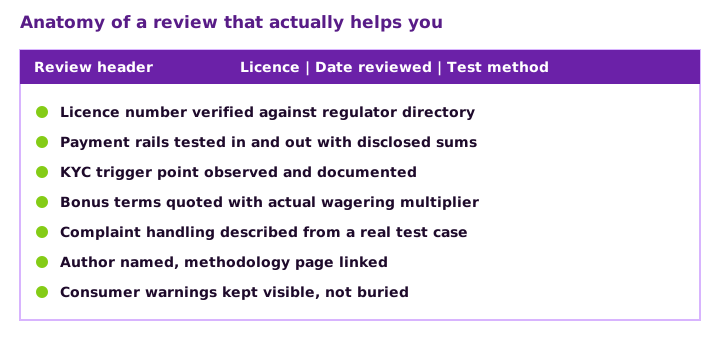
A useful review of a non gamstop casinos operator has a testable structure. It names the operator, the licence number, the date reviewed, the sums used, and the outcomes at each step. It gives you enough information that a second reader could repeat the test and expect broadly the same result. Our editorial view is that anything less is a marketing page dressed up as a review. See our non gamstop casinos homepage for the underlying licensing framework we cross-check against.
The core sections we look for are: licence verification, payment rails tested in and out, KYC observation, bonus terms with a worked example, complaint-handling test, and a named reviewer with a link to a public methodology page. None of these is unusual on a mature review site. Their absence in a review of an offshore operator is the interesting signal.
A review that scores an operator 5/5 without explaining how the score was reached is not a review. A review that scores 4.7/5 with a paragraph explaining the specific 0.3-mark deduction, dated and signed, is a review. That distinction is the most important quality filter you can apply when scanning “non gamstop casinos reviews” pages in search results.
What separates verified reviews from self-declared ones?
A verified review is one where the reviewer actually deposited, played, withdrew, and observed the process end-to-end. It carries a real deposit amount, a real withdrawal amount, a real elapsed time, and a real outcome at KYC. A self-declared review is one where the reviewer describes the operator based on the marketing page and third-party summaries without having tested the cashier.
The difference is enormous, but it is often invisible in the review itself. Verified reviews take time and money to produce — a full test cycle costs the reviewer real cash and a few working days — so the good ones tend to cover a small number of operators per period. Self-declared reviews scale to hundreds of operators because they need only a copywriter and an affiliate feed.
| Attribute | Verified review | Self-declared review |
|---|---|---|
| Reviewer named | Yes, with author page | Often absent or generic |
| Test sums disclosed | Real numbers | Not stated |
| KYC observation | Documented | Generic paragraph |
| Withdrawal timing | Real elapsed hours | Repeats marketing claim |
| Complaint handling | Tested with a real ticket | Not tested |
| Update history | Dated revisions | Silent updates or none |
Which review red flags should always slow you down?
Six review red flags recur across the offshore market. First, all-five-star ratings on the review portal itself. A serious portal shows a range of scores and the operators receive a spread of ratings. A wall of five stars usually means the portal is either paid-editorial or auto-generated.
Second, no named reviewer. If the review is attributed to “the editorial team” and no team page names actual people, treat the review as anonymous. Named reviewers with public profiles are the norm at trustworthy consumer publications.
Third, generic bullet points identical across sites. Copy-paste patterns are visible if you compare the same operator’s review on two portals. Where the two portals use the same phrases, the same bonus number, and the same praise for “the customer support”, the review is not independent.
Fourth, no test-method page. A serious portal explains how it evaluates operators: what it tests, what it does not, and how it scores. A portal without a methodology page is not making its evaluation reproducible.
Fifth, affiliate disclosures either missing or buried. Legally in the UK, affiliate revenue must be disclosed clearly under CMA guidance. An offshore-focused portal that hides its commercial relationship is failing that standard.
Sixth, no negative reviews visible anywhere on the site. Even the best-run operator gets some negative reviews. A portal that shows only praise is filtering for commercial reasons.
How do editors verify an operator’s licence claim?
The first check is the operator’s own footer. A well-run operator publishes its regulator (Curacao GCB, Anjouan Offshore Gaming, MGA), its specific licence number, and a hyperlink to the regulator’s verification page. A missing regulator name or a broken verification link is a strong initial signal.
The second check is the regulator’s public directory. Each of Curacao, Anjouan and Malta maintains a searchable list of active licences. A licence number that returns an active record with the operator’s corporate name is a genuine licence. A licence number that returns no result, or points at a different operator name, is not.
The third check is the corporate registration itself. Curacao and Anjouan both require an incorporated entity; Malta requires a full company registration. The operator’s cashier terms and privacy policy should name the same company and address as the regulator’s directory. A mismatch here is a serious issue.
- Regulator named, licence number displayed and verification link working
- Regulator directory returns an active record for that licence number
- Operator’s corporate name matches the directory entry
- Company address is consistent across cashier terms and directory
- Company address has a real business footprint, not a mailbox-only registration
What payments testing is worth doing before publishing?
A published review that describes a cashier without ever depositing at it is not a payments test. A useful review disclose the rail used for deposit, the exact sum, the time from click-to-credit, and any decline messages encountered. The same disclosure applies to the withdrawal side.
Testing a single rail is thin. A rounded review tests at least two: usually a UK debit card and either an e-wallet or crypto. Deposit and withdrawal times differ by rail, so a review that only tests card gives a partial picture. Reviewers who care about payments spend the money on two cycles.
Bank-side behaviour is important to document. If a UK issuer blocks the deposit, that is not the operator’s fault, but it is information a UK reader wants. Good reviews note bank-block messages by issuer without generalising them across the whole card scheme. A single block at a single bank is a data point, not a verdict.
How should reviews describe KYC observation?
KYC observation is the single most valuable field in a non-GamStop casino review, because delayed-KYC is the most-complained-about aspect of the offshore market. The reviewer should note the trigger point (deposit amount, withdrawal amount, or cumulative activity), the documents requested, the elapsed time to review, and the tone of communication during the wait.
The typical pattern is that first-time KYC triggers at the first withdrawal above a threshold, takes 24-72 hours to review, and requires passport-or-driving-licence plus proof of address. Deviations from that pattern — particularly review times exceeding a week — are the type of data point that separates operators.
Reviews that never mention KYC have almost certainly not tested a withdrawal. That is a soft red flag: the reviewer stopped at deposit and did not run the cashier to its conclusion. Where a reviewer says “withdrawals are fast” without disclosing an actual withdrawal, they are quoting the marketing page, not observing the cashier.
Which bonus checks belong in every review?
Five bonus checks separate a useful review from a marketing summary. First, the wagering multiplier and whether it applies to bonus-only or deposit-plus-bonus. Second, the maximum bet permitted during wagering. Third, the maximum cashout when the balance clears. Fourth, the game weightings, particularly the difference between slots and live-dealer games. Fifth, the time window.
A worked example illustrates the value. Consider a 200% welcome offer at a non-GamStop operator. Deposit £100, notional balance £300 (of which £200 is bonus), wagering multiplier 60x on bonus-only, max bet £5, max cashout £500, 30-day window, slots weighted 100%. The turnover requirement is 60 × £200 = £12,000. On a 96% RTP slot the expected loss over that turnover is around £480, before any variance.
Working through that maths in the review lets a reader compare offers on a like-for-like basis. Two offers with identical headlines can produce very different expected outcomes once the wagering, max cashout and game weightings are considered. Reviews that quote the headline without the maths are not doing the job.
What makes complaint-handling testable in a review?
Complaint handling is the hardest section to test because it requires the reviewer to have an actual complaint. The good approach is to raise a low-stakes ticket — a question about the cashier terms, or a request for KYC status — and observe the response time, the tone, and the accuracy of the answer.
What matters is whether the operator responds within a stated window, whether the answer is factually correct, and whether escalations go to a human. Response quality is usually a proxy for the wider operational discipline of the business. Fast, accurate support correlates with fast, correct withdrawals.
Reviews that never test a support ticket have almost no information about complaint handling. “24/7 live chat available” is a marketing claim; whether the chat actually resolves a query is a testable outcome. Look for reviews that quote the exact response time and the substance of the reply.
How should reviews treat operator responses?
When an operator disputes a review, the response deserves to be published. A serious portal publishes the operator’s reply in full, dated, and unedited except for redactions of personal information. That approach preserves the reader’s ability to judge the exchange on its merits.
Silent post-publication edits are the opposite pattern. A review that says one thing on Monday and something different on Wednesday, with no note of the change, is not accountable. Editorial policy should require a dated corrections log for any substantive edit.
The wider point is that reviews are conversations. An operator that engages with legitimate criticism, corrects a factual error politely, or explains a policy change is behaving well. An operator that responds with lawyers’ letters to any negative coverage is behaving less well. That texture is visible in the reviews you read, if the portal allows it to be.
Publishing a corrections log alongside the review is another marker of accountability. A dated log that says “3 August: updated withdrawal timings after a fresh test” is far more useful than a silent republishing that changes the numbers without acknowledgement. The correction itself is not a weakness; the willingness to record it is a strength.
Finally, consider how the portal handles rebuttal from readers as well as operators. If reader comments are switched off, or curated to remove critical voices, the review is one-way. Portals that publish reader complaints alongside operator responses tell you more about the underlying quality of the cashier than any headline score. The best offshore reviews sit somewhere between an operational audit and a consumer diary, with all the parties’ voices visible.
Frequently Asked Questions
What should a non-GamStop casino review actually cover?
A licence check against the regulator directory, the payment rails tested in and out, KYC trigger point, bonus wagering multiplier, complaint handling test, corporate ownership, cashier terms review, and a named author with a public methodology.
How can you tell a verified review from a marketing review?
A verified review names the reviewer, the date, the sums used, and the outcomes at each step. A marketing review reads as generic prose, has no test method, and often has a five-star rating regardless of the operator’s actual behaviour.
What are the biggest review red flags?
All-five-star ratings with brand-new dates, no named reviewer, generic bullet points identical across sites, no test-method page, and affiliate disclosures either missing or buried at the bottom of the site.
Do offshore casino reviews check the licence?
The good ones do. They quote the specific licence number from the operator footer, cross-check it against the regulator directory, and report whether the linked verification page returns a live licence. Reviews that skip this step should be treated as marketing.
How do reviews handle payments testing?
A worthwhile review discloses the sums used, the deposit rail, the time to credit, the withdrawal rail, the time to receipt, and any bank-side blocks encountered. This costs the reviewer real money and takes time; expect verified reviews to run through only a few operators per period.
How should KYC observation appear in a review?
It should describe the trigger point (usually the first withdrawal above a threshold), the documents requested, the time taken to review and the tone of communication during the wait. A review that never mentions KYC has not tested a withdrawal.
Which bonus tests belong in a review?
Wagering multiplier calculation, max-bet-during-bonus rule, max cashout, game weightings and the time window. Ideally the reviewer takes the offer, meets the wagering conditions, and reports whether the balance actually cleared to withdrawable status.
How does the review handle operator responses?
Good reviews publish operator responses in full, dated, and unedited except for redactions of personal information. A review that quietly changes after publication without a corrections note is not accountable.
Responsible Gambling
UK support is available whether or not you are self-excluded. GamCare National Gambling Helpline: 0808 8020 133. GordonMoody for residential care. NHS National Gambling Clinic for specialist statutory treatment. BeGambleAware for coordination and prevention. GAM-Anon for family and affected others.
Background reading on consumer-review methodology — not gambling help — is at Wikipedia. UK Competition and Markets Authority guidance on affiliate disclosure sits at gov.uk.