 ML Info
Answered Non GamStop Casinos FAQ 2026 — Every UK Query
This non gamstop casinos faq collects the questions UK readers ask us most often. It is written to be read straight through or dipped into. Every answer is editor voice: no marketing gloss, no operator ranking, no affiliate links.
What is this non GamStop casinos FAQ for?
Search demand for a non gamstop casinos faq comes from readers who have already met the phrase somewhere and want a straight description of what it means. Our editorial view is that a good FAQ starts from the questions people actually type. It does not lead with the answers you would like them to hear. If you came to this page from a search box, the goal is to save you the next three tabs.
The FAQ format also has a structural virtue: each question stands on its own. You can jump straight to the payments section, the KYC section, or the disputes section without reading the whole page. The trade-off is that context is thinner than in a long-form article. Where a question needs more mechanics, we point at the non gamstop casinos homepage or the two sub-pages on new launches and reviews.
You should treat this FAQ as description, not endorsement. We do not name specific operators, we do not run rankings, and we do not receive commissions. The tone is deliberately consumer-side. If you conclude, halfway through, that you would rather not deposit at an offshore operator, that is a valid outcome of reading the page and no reason to keep going.
Which questions do UK readers ask most often?
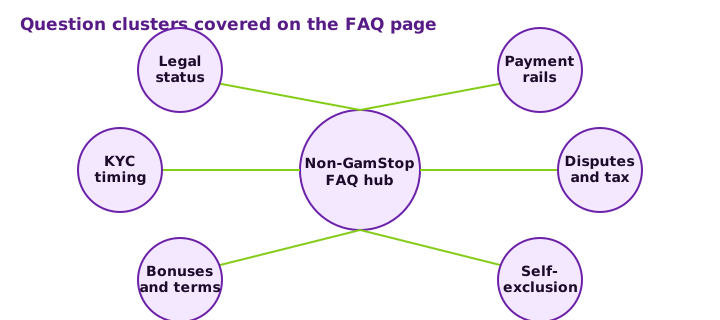
Six clusters absorb most of the traffic we see. Legality is the first: readers want to know whether opening an account or depositing is a criminal issue. Licensing is the second: which regulator issued the licence and what that regulator actually does. Identity verification is the third: whether KYC still applies and when. Payments is the fourth: which cards work, which do not, and why. Bonuses is the fifth: how welcome offers really behave once you look at the wagering multipliers. Disputes and self-exclusion round out the list.
Behind each cluster there is a hidden question: what happens when it goes wrong. That is the question this FAQ is really answering, and it is the reason we hold the tone consumer-side. If a headline offer at a Curacao-licensed casino works out well, no one needs an FAQ. If it doesn’t, you need to know what your options are before you deposit, not after.
| Cluster | Typical top question | Where we cover it |
|---|---|---|
| Legal | Is it legal for me to play? | Legality section below |
| Licensing | Who regulates them? | Licensing section below |
| KYC | Do they check my ID? | Identity section below |
| Payments | Will my card work? | Payments section below |
| Bonuses | Is the offer worth it? | Bonuses section below |
| Disputes | Who do I complain to? | Disputes section below |
| Self-exclusion | Can they still take me? | Self-exclusion section below |
How does the legality question really break down?
The compressed answer — not criminal for a UK player — masks three sub-questions. First, is it legal for the operator to serve you? Formally, an operator without a UKGC licence marketing to UK residents is exposed to UKGC enforcement, which the regulator does exercise. That is the operator’s risk, not yours as a consumer.
Second, is it legal for your bank to process the transaction? Under the FCA payment-services rules the bank has discretion and can refuse a gambling merchant category code where its risk framework points that way. Some UK banks decline gambling deposits to any offshore-licensed operator as a matter of policy. Others process them.
Third, is the outcome legal? Winnings from a non-UKGC operator are still winnings; they are not stolen goods. HMRC treats them the same as UKGC winnings — not subject to UK income tax for individuals. But the operator’s obligation to pay you those winnings is governed by the offshore licence terms, not by UK law. That is the shift with real consequences.
The overall picture is that legality is intact for the player, but the enforcement machinery around it is very different from the UKGC world. Anyone treating this page as a legal-advice document should stop; a solicitor is the right source for individual circumstances.
What do people ask about offshore licensing?
The most common licensing question is “who”. The answer is one of three regulators in nearly every case: Curacao Gaming Control Board, Anjouan Offshore Gaming, or Malta Gaming Authority. Curacao dominates. Since December 2024 its licences have been issued under the LOK framework, which is a genuine step up from the earlier master/sub-licence system but is still not as rigorous as the UKGC.
The second question is “how do I verify”. A well-run operator names its regulator and licence number in the footer and links to the regulator’s public verification page. If either is missing, the licensing claim should be treated as unverified. It is worth spending two minutes checking that the licence number on the operator’s site matches an active licence on the regulator’s register.
The third question is “what does the licence give me”. The honest answer is: less than a UKGC licence, and much less than most UK consumers assume. Offshore regulators have a lighter footprint in complaint handling and generally no compulsion powers over operators outside routine renewal.
What do readers ask about identity verification?
“Do they still check my ID?” is the single most common question in this cluster. Yes: at any operator that intends to pay withdrawals. Anti-money-laundering rules apply across jurisdictions, and the payment processors sitting between the casino and the card networks have their own compliance overheads that trigger KYC.
“When does the check happen?” is the follow-up. Almost always at the first withdrawal above a low threshold — often €100 or €500. Between sign-up and that threshold the account may exist with only an email address and a date-of-birth declaration. That is the practical origin of the “non-KYC casino” framing you see in marketing copy.
“What do they ask for?” is standard: a clear colour scan of a passport or driving licence, a recent utility bill or bank statement (dated within the last three months), and, above larger thresholds, a note or statement showing where the money came from. Selfies with your ID or with a dated piece of paper are increasingly common.
“How long does the review take?” The first-time review takes 24 to 72 hours, longer over UK bank holidays. Subsequent withdrawals to the same rail are usually much faster. Delayed KYC is the biggest single source of complaint traffic about offshore operators.
Which payment questions repeat every week?
Card acceptance leads the list. Readers ask whether a UK-issued Visa or Mastercard debit card will work. The answer is: sometimes. UK banks apply their own controls under the FCA framework, and some decline gambling merchant category codes to unlicensed-in-the-UK operators. A card that works at one non-GamStop site may not work at another.
E-wallets are the second cluster. Skrill, Neteller and MuchBetter cover most of this segment. They add a layer of KYC of their own, and they usually mask the merchant name on your bank statement (you see the wallet, not the casino). Fee schedules vary.
Crypto is the third. Bitcoin, Ethereum and USDT (typically on TRC-20) are the three most commonly accepted assets. Crypto does not remove KYC at withdrawal at any operator staying in business. It also carries its own risks: paste the wrong address and the funds are gone, price movement affects your balance, and network fees are volatile.
The fourth cluster is fees. Currency conversion of 1% to 3%, card-processor surcharges, minimum withdrawal thresholds and dormancy fees are the four to look for in the cashier terms before you deposit.
How does the bonus question turn into a wagering question?
Non-GamStop bonus offers look enormous on the surface. 200%, 300% or higher matches are common on the marketing page. The mechanics that decide whether the balance is usable are wagering multipliers, max-bet-during-bonus rules, max-cashout limits, game weightings, and time windows. Each of those is normally in the small print of the offer, not in the headline.
A worked example illustrates the point. If you deposit £100 and take a 200% welcome bonus, the notional balance is £300. If the wagering multiplier is 60x on bonus-only funds, you have to wager £18,000 through the games before any winnings clear to withdrawable status. On a 96% RTP slot the expected loss over that turnover is around £720. That is why the “big bonus” can end up costing more than a smaller bonus with lower wagering.
- Check the wagering multiplier (bonus-only or deposit-plus-bonus)
- Check the maximum bet permitted during wagering
- Check the maximum cashout when the balance clears
- Check the game weightings, particularly slots vs live games
- Check the time window and any bonus-abuse clause
None of the above says a bonus is a bad idea in every case. Some smaller, cleaner offers — a 50% match with 20x on deposit-plus-bonus and no max cashout — are meaningfully better than a headline 300% number. Reading the bonus terms in full is the only way to know.
What does the FAQ say about disputes and refunds?
Two dispute questions dominate. The first is “the operator refuses to pay”. Answer: escalate to their complaints team in writing, then to their offshore regulator, then consider whether a card-issuer chargeback applies. UKGC and IBAS do not cover the operator. The offshore regulator route is slow. Chargeback is narrow.
The second is “a bonus was voided and I lost real-money winnings”. This is more common than a flat refusal. It usually flows from breach of a bonus term — a max-bet violation during wagering, or a game-weighting rule — and the operator has usually documented the reason. Your escalation route is the same, but the operator’s position is stronger because a contractual term was breached.
The third, less-common question is “my deposit was taken but not credited”. Bank statement, processor reference number, and a written complaint to the operator are the standard starting points. If the operator does not respond within ten working days, escalate to the card issuer or the payment processor.
None of these routes is fast. All of them are less accountable than a UKGC complaint. Budget accordingly.
How does self-exclusion enter the FAQ picture?
Some readers arrive at a non gamstop casinos faq because a GamStop self-exclusion is in force and they are looking for a route to continue playing. This is the single point where an FAQ has to shift out of pure description. We do not describe workarounds. We describe the market, and we say clearly that a self-exclusion should be respected.
The mechanical reason is that KYC will link your play to your real identity at any operator that plans to pay a withdrawal. There is no anonymous route through the offshore market that survives the withdrawal step. Attempting one is a very common source of unpaid balances and permanent account closures.
The human reason is that self-exclusion exists for a reason. The financial and personal cost of returning to gambling during an active GamStop period tends to be much higher than the cost of waiting out the term. That is not marketing copy; it is the pattern we see repeatedly in reader correspondence.
Frequently Asked Questions
Are non GamStop casinos legal in the UK?
For an individual UK adult, placing a bet at a non-UKGC site is not a criminal act. Enforcement action sits with the operator, not the player. The material downside is that UK-based complaint routes do not reach an offshore-licensed operator.
Which offshore licences appear most often in the FAQ?
Curacao GCB under the LOK regime is the most common. Anjouan Offshore Gaming is a lighter-touch alternative and Malta Gaming Authority is stricter. Kahnawake appears occasionally but has a small UK-facing footprint.
Do non GamStop casinos still ask for ID?
Yes, at any operator that plans to pay withdrawals. KYC is often delayed until the first payout above a low threshold, which is what people describe as a no-KYC deposit experience. The check itself is not skipped.
Can I use my UK bank card at these sites?
Sometimes. Your card may authorise or your issuer may decline, based on their own gambling merchant category policies. The decision sits with the bank, not the casino. Card acceptance also varies by processor.
Are casino bonuses different at non GamStop sites?
Headline percentages are often larger, but wagering multipliers, max-bet-during-bonus rules and max-cashout caps are correspondingly heavier. Read the bonus terms, particularly the wagering multiplier and max cashout, before you accept.
What happens if I have a payout dispute?
You escalate to the operator, then to its licensing regulator. UKGC and IBAS cannot help. A card chargeback is possible only in narrow circumstances. Deposits at non-UKGC operators should be sums you can genuinely lose.
Does GamStop apply to any non GamStop casino?
By definition, no. GamStop is a UKGC licence condition. Non-GamStop operators sit outside that licence. If you are self-excluded through GamStop the appropriate step is to let the exclusion run and seek support.
What UK support is available for gambling harm?
GamCare runs the National Gambling Helpline on 0808 8020 133. GordonMoody offers residential treatment. NHS National Gambling Clinic provides specialist care. BeGambleAware coordinates support. GAM-Anon supports family members.
Responsible Gambling
UK support is available. GamCare’s National Gambling Helpline is 0808 8020 133. GordonMoody offers structured residential care. NHS National Gambling Clinic is the specialist statutory route. BeGambleAware coordinates prevention and support. GAM-Anon supports family and affected others. We name them here rather than linking, so a reader on a gambling-adjacent page is not sent to a help URL through an unfamiliar click.
General background reading — not gambling-help pages — is on Wikipedia. The Gambling Act 2005 itself is at legislation.gov.uk.