 ML Info
Answered New Non GamStop Casinos 2026 — What Launches Signal
Search demand for new non gamstop casinos has grown every quarter since 2023. This page unpicks what “new” really means, what the launch signals tell you, and why fresh brands carry higher risk than the established ones.
What counts as a “new” non-GamStop casino?
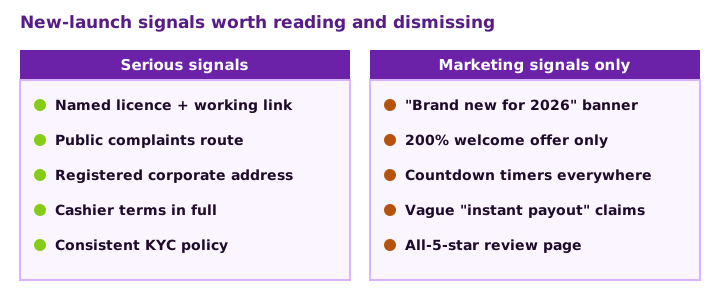
In casual usage, a “new” non-GamStop casino is one that has been live for under twelve months. Below that line the operator has a short deposit-and-withdrawal history, a small complaint file, and marketing that leans hard on the “fresh” framing. Above the line, patterns start to form and the operator is legible in a different way.
The definition is looser than it sounds. Some “new” brands are skins over an existing white-label platform run by an established company — a fresh logo, fresh domain, same back office. Others are genuinely new companies with a first-time management team and a first-time cashier relationship. The two carry very different risk profiles even though they look similar on the surface. Our non gamstop casinos homepage covers the underlying licensing framework that governs both.
What you can rely on is that the marketing tone will emphasise novelty. Countdown timers, “launch offer” banners, oversize welcome bonuses and heavy affiliate campaigns are the usual signals. That does not mean a new operator is untrustworthy; it means the tools they have available to attract attention are different from those of a five-year-old brand with a genuine reputation.
Why do so many new offshore brands launch each year?
Three structural factors drive the churn. First, the cost of an offshore licence is much lower than a UKGC licence, and the lead time is shorter. A Curacao LOK licence takes months, not years. Anjouan is quicker still. That accessibility encourages new entrants.
Second, white-label platforms make the technical build cheap. A single provider — typically Softswiss, EveryMatrix, SoftGamings or similar — can spin up a full-feature casino site with cashier, KYC integration and games catalogue in weeks. Operators do not need to build the platform; they need to build the brand.
Third, the SEO landscape rewards fresh domains for search phrases such as “new non gamstop casinos”. Affiliate publishers rotate their coverage towards new launches to catch that traffic. That in turn means marketing spend is concentrated at launch, which produces the visible pattern of oversize welcome offers.
None of that is inherently sinister. It is a mature market operating under its own economics. But it does explain why any given month brings several new brands, and why the “new casino” category is a moving target rather than a small, stable set.
What genuinely new-launch signals should you look for?
Underneath the marketing gloss, a handful of signals separate a serious new operator from a throwaway launch. A named regulator and verifiable licence number in the footer is the first. A well-run new operator publishes its Curacao GCB or Anjouan licence number, links to the regulator’s verification page, and shows a working link on that regulator’s directory.
The second signal is a full corporate address and named holding company. Curacao and Anjouan both require this at licence level; the operator’s decision to make it visible on the site is a proxy for how transparent the wider operation is. A Cyprus or Estonia holding company is not itself a red flag; a shell address with no other visible business is.
The third signal is the completeness of the cashier terms. Look for wagering multipliers, max-bet-during-bonus rules, max-cashout limits, KYC triggers, dormancy fees and minimum withdrawal thresholds — all in the terms page, not scattered in help articles. Missing sections often become the source of later disputes.
- Named regulator and verifiable licence number
- Full corporate address and named holding company
- Cashier terms complete and easy to find
- Clear KYC policy including trigger points and document list
- Working complaints route with a stated response time
- Support that answers withdrawal questions with a documented path
Which marketing signals mean nothing on their own?
A large number of “launch signals” you see in reviews or on the operator’s own site are marketing noise. Countdown timers on the welcome offer are the clearest example: they are designed to create urgency, not to reflect real deadlines. The offer usually returns unchanged after the timer expires.
Oversize welcome bonuses of 200% or higher are another. On any offshore site, a 300% match is very unlikely to be usable without heavy wagering conditions. The wagering multiplier is where the real cost of the bonus sits, and it is nearly always disproportionately larger on the biggest headline offer.
“Instant payout” claims mean the payout rail is fast — usually crypto or an e-wallet. They do not mean the total time from withdrawal request to money-in-your-account is instant. The KYC step, which happens on the first payout regardless of rail, dominates elapsed time on a first withdrawal.
All-five-star review sections on the operator’s own site are marketing, not evidence. Independent reviews on a range of dates, with both praise and criticism, are the type of trail a genuinely trustworthy new brand accumulates. A wall of 5-star reviews all from the same fortnight is a plausible sign the operator has commissioned the reviews itself.
Why do new operators carry disproportionate risk?
Three risk factors weigh heavier on a new brand than on an established one. First, the operator’s back-office processes are new. KYC teams are inexperienced, complaint handling is untested, and the internal escalation ladder is short. Errors that a mature operator would have designed out show up more often.
Second, the payment-processor relationship is fragile. Card processors sometimes pull support from a new brand within the first year, particularly if fraud rates or chargebacks tick above their thresholds. When that happens, deposits stop working and existing balances can take longer to withdraw.
Third, the operator’s financial position is unproven. Casinos hedge against variance in games outcomes with balance-sheet buffers, and a new operator without a strong parent may struggle to pay a large win at the wrong moment. Genuine solvency issues are rare but they do occur.
The visible consequence is that early complaints against new operators cluster in three places: bonus voids, KYC delays and payout processing. If you deposit at a new brand, expect these patterns to be more common than at a five-year-old operator. Budget deposits at a level you can absolutely afford to lose.
How do new offshore licences actually get issued?
Under the Curacao LOK framework, an operator applies to the Gaming Control Board directly. The GCB conducts due diligence on the beneficial owner, the corporate structure, the software supplier and the technical set-up. Once granted, the licence is registered in the GCB’s public directory with a unique number.
Anjouan Offshore Gaming operates a lighter-touch process. Licences are administered through a small number of authorised agents, cost less, and are issued more quickly than a Curacao licence. The registry is public and licence numbers can be verified through the official portal.
Malta Gaming Authority licences are the strictest of the offshore options. The MGA runs a formal application process closer in structure to the UKGC: extensive corporate disclosure, technical audit, financial due diligence and ongoing supervision. Very few brand-new casinos choose to go straight to MGA; those that do tend to be spin-offs of established operators.
| Regulator | Time to issue | Cost band | Ongoing supervision |
|---|---|---|---|
| Curacao GCB (LOK) | Several months | Medium | Formal, mid-strength |
| Anjouan OG | Weeks to a few months | Low | Light |
| Malta Gaming Authority | Months, sometimes a year | High | Strong |
| Kahnawake | Months | Medium | Moderate, small footprint |
Do new sites use different bonus structures?
New non-GamStop operators lean heavily on welcome offers. Ratios of 200% to 500%, or free-spin packages of 200 spins or more, are typical. The purpose is to attract initial deposits during a period when the brand has no track record and no organic search share. The economics of that offer live in the wagering terms.
Compared with an established brand, a new operator will often use a higher wagering multiplier (60x to 80x on bonus is common), a stricter max-bet-during-bonus rule (often £5 per spin), a lower max cashout, and shorter validity windows. The result is a bonus that looks big at the point of claim and is genuinely difficult to convert into withdrawable balance.
None of this makes the offer a scam. It reflects the economics of attracting first-deposit traffic under offshore conditions. What it does mean is that reading the bonus terms is more important at a new operator than at a five-year-old one. A smaller-headline, cleaner offer — 50% match with 20x wagering on deposit-plus-bonus and a £500 max cashout — can be a much better trade than a 400% headline with 80x on bonus and a £100 max cashout.
How do payment rails behave at a fresh cashier?
Card acceptance is patchy at a new brand. Some UK issuers block gambling merchant category codes to newly acquired merchants until they see a clean payment history — a couple of months of low chargeback rates. In practice this means a card that works at your usual site may decline at a new one for the first few weeks after launch.
E-wallets are usually available from launch. Skrill, Neteller and MuchBetter are the three most common. Wallet KYC is separate from operator KYC, so you may be asked twice for identification if your wallet is also fresh. Crypto rails almost always work from day one because they require no acquirer-side relationship at all.
Withdrawal rails behave a little differently. Fast rails (e-wallet, crypto) are usually enabled at launch. Slower rails (bank transfer, card withdrawal via Visa Direct) may take longer to be enabled or be capped at low sums initially. Read the withdrawal-methods table in the cashier before you deposit if payout method matters to you.
What early complaints patterns do new operators show?
Three complaint clusters appear repeatedly in the first three to six months at a new offshore brand. First, bonus-void complaints: a customer wins on a bonus balance, the operator finds a max-bet-during-bonus breach or a game-weighting rule breach, and voids the balance. This is the most common early complaint and often the most contentious.
Second, KYC-delay complaints: the first withdrawal triggers full identity verification, and the review takes longer than the customer expects. At a mature brand this is 24 to 72 hours. At a new brand it can stretch to a week or more while the KYC team beds in. Communication during the wait is a big driver of complaint volume; well-run new operators keep customers updated.
Third, payment-processor complaints: deposits appear on the bank statement but do not credit the casino balance, or withdrawals to card are refused with a processor error. These usually resolve within a week but generate a lot of anxiety. See our reviews page for how we test operator responses.
Frequently Asked Questions
What does “new” mean for a non-GamStop casino?
In practice, “new” usually means the operator has been live for under 12 months, has a small deposit-and-withdrawal history and is running headline bonuses to attract initial traffic. Some are new brand skins over an existing operator; others are genuinely new companies.
Why do new offshore brands launch so often?
Offshore licence costs are lower than a UKGC licence and lead times shorter. Marketing SEO plays reward fresh domains for the phrase “new casinos”. White-label platforms let operators launch a full site in weeks rather than months.
Are new non-GamStop casinos riskier than established ones?
As a group, yes. Track record is short, complaint patterns are unformed and payment relationships less stable. Individual operators may be run competently, but a new brand carries higher variance for a UK consumer.
What launch signals actually matter?
A named regulator and verifiable licence number, a full corporate address, cashier terms visible in full, a clear KYC policy and a working complaints route. Countdown timers, oversized welcome bonuses and “instant payout” claims are marketing signals only.
Does the LOK Curacao regime affect new launches?
Yes. Since December 2024 new Curacao licences have been issued directly by the Gaming Control Board under the National Ordinance on Games of Chance. In principle this is stricter than the earlier master/sub-licence model but the effect on complaint outcomes is still bedding in.
Do new operators pay withdrawals faster?
Sometimes, deliberately, to build trust. But KYC review at first withdrawal remains the norm. Advertised times of “minutes” refer to the payout rail after KYC, not to the total elapsed time from request to receipt.
What do early complaint patterns look like?
The first three months at a new offshore casino tend to show heavier bonus-voiding complaints, longer initial KYC queues and unstable payment processors. These patterns usually calm as the operator’s back office matures.
Should UK consumers avoid new offshore operators entirely?
Not necessarily. But the burden of due diligence is higher and any deposit should be a sum you can genuinely afford to lose without impact. Established operators have complaint histories you can read; new operators do not.
Responsible Gambling
Support in the UK is available whether or not you are self-excluded. GamCare National Gambling Helpline: 0808 8020 133. GordonMoody for residential treatment. NHS National Gambling Clinic for specialist statutory care. BeGambleAware for prevention and coordination. GAM-Anon for affected family members.
General context on offshore-licensed operators is at Wikipedia. The UK statutory framework itself is at legislation.gov.uk.